THINKER

Your patients should hear about stem cells from you.

THINKER staffs and runs the part of your practice that talks to patients: the platform, the science-based content, and a trained specialist who operates it.

Access by invitation.

The idea you had in March is still an idea in September.

You already know your patients should hear from you. It has not gone out because nobody in your practice has time to do it, and you are busy seeing patients.

Software waits to be opened.It holds your contacts and does nothing until someone sits down with it.
An agency waits to be briefed.It needs direction you do not have time to give, and it rarely reads the science.
We staff the work and run it.A specialist operates your system on schedule, from content already written from published studies.

Everything we do, in a few minutes.

Open full screen

Click the right side of the presentation, or use the arrow keys, to move through it.

The most expensive post is the one that never goes out.

Waiting costs you reachable patients.

An email list left alone wears out. In 2025, ZeroBounce found at least 23% of the emails it checked were invalid or risky. A dormant list also needs weeks of careful warming before it can be emailed safely.

Source: ZeroBounce, The Email List Decay Report for 2026, based on more than 11 billion email addresses verified from January to December 2025. Published February 2026.

The riskiest post is the one without the science behind it.

Patient education is safest when it rests on published studies. Nobody in a busy practice has time to read them, and a post written without them, or with a required notice set wrong, is the one that causes trouble.

Hiring the pieces does not fix it.

Doing this properly takes a marketer, a CRM specialist, a science writer, compliance-ready templates, a content producer and an assistant. Someone still has to manage them, and if nobody does, nothing goes out.

We staff this work and run it, so none of these costs is yours. Pricing is set on a first call.

Book a call

One team runs the whole system, so you are not stitching it together.

  • A trained specialist operates it.

    Your specialist works inside your own CRM at your direction.

  • Your CRM, with HIPAA configuration.

    The account is yours. Your patient data stays in it, and it leaves with you if you leave us.

  • Content written from published studies.

    Summaries for your staff, plain-language versions for your patients, emails, newsletters, social posts and landing pages.

  • Compliance built into the templates.

    Required notices and disclosures are part of each template before any copy is written.

What you get along with the platform: a human specialist and landing pages

A specialist working at a desk in an office
THINKER Manpower (Philippines)

Your specialist is employed by THINKER and by Manpower Philippines, the Philippine franchise of ManpowerGroup, under a staffing arrangement, and works inside your own CRM at your direction.

  • Manages your compliant patient and community outreach in your own CRM
  • Manages your agentic AI dashboard
  • Works under your supervision, on your terms
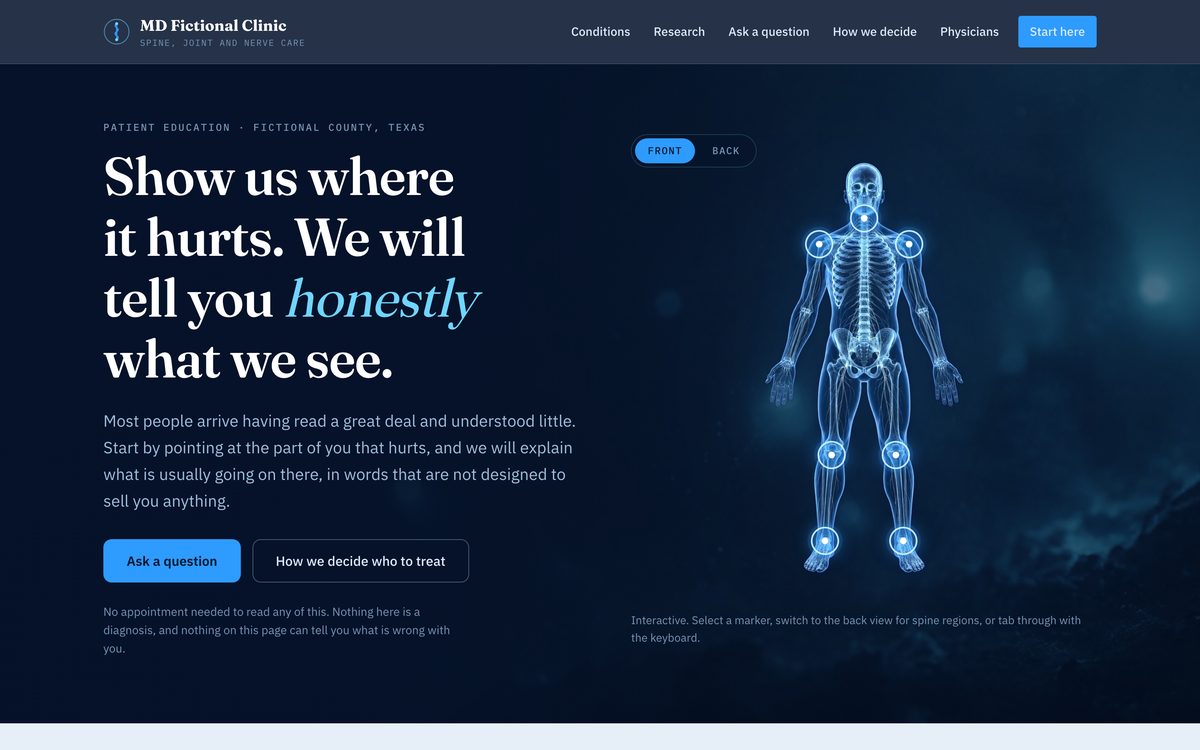
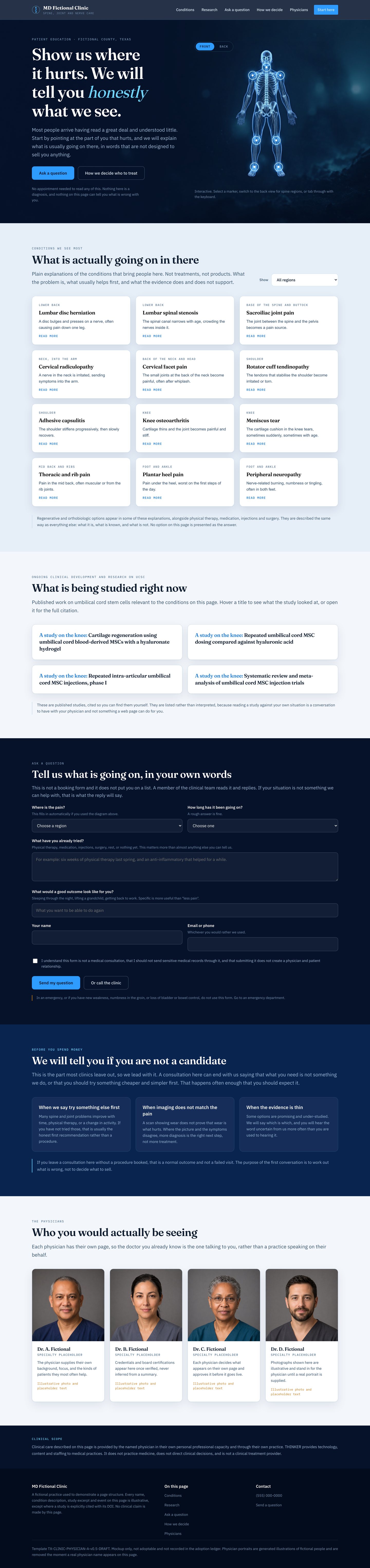
A sample clinic landing page

Physician and clinic page

A sample page built for a fictional clinic. Your practice owns the page and the domain.

You approve once, and your specialist does the rest.

  1. We prepare your list and pages.

    Month one is list cleanup, safe warming of dormant addresses, and your landing pages. Nothing goes to a patient yet.

  2. You approve the content library.

    You review and approve the library once, and we record what you approved and when.

  3. Your specialist sends on schedule.

    From month two, content goes out on an agreed cadence. You review exceptions, not every email, and nothing reaches a patient without your approval.

This is sample content that can be branded under your clinic and sent to your patients.

A video from the stem cell education series, with its full script and sources.

Read the script

Hi, I'm Saffron, the AI assistant of your clinic. Today I'm working on a story that sounds like science fiction, except one part of it is already medicine, and the rest is still being tested. Both halves are worth knowing.

Picture a delivery room. A baby is born. And in the rush of that moment, something gets discarded: the umbilical cord and the blood inside it. For decades it went straight in the trash. Nobody looked twice.

Then scientists looked closer.

Inside that blood are stem cells, including blood-forming cells and a population researchers call mesenchymal stromal cells. What those cells might do in the body is an active research question. Reviews of the field describe a broad range of proposed mechanisms being studied, including cell migration and homing, the formation of new blood vessels, and effects on inflammation. Those are hypotheses under investigation, not established functions.

But one part of this story is not a hypothesis.

In 2011, the FDA gave full approval to the first cord blood-derived cell therapy. It is used in transplantation for a defined list of serious blood and immune conditions. That list includes certain blood cancers, a small number of inherited disorders, and forms of bone marrow failure. In most cases, it applies to patients who have already tried conventional treatment and have not been helped by it.

That is worth sitting with. A substance that was medical waste for most of history became an approved therapy, for a specific and limited set of very serious conditions.

Notice how precise that is. It is not an approval of cord blood in general. It is one product, for one defined list.

And that approval did not close the story. It raised a research question that remains open today.

So let me tell you where the science currently stands, with one caveat first, because it applies to everything that follows. All four of these areas are early-phase research. Most of the studies are small. Some effects observed have lasted only weeks. The reviews themselves note that turning any of this into a widely available therapy involves substantial regulatory and manufacturing hurdles that remain unresolved. None of what comes next is available treatment.

With that said.

First, cancer-fighting T-cells. Researchers are engineering cord blood T-cells to recognize specific cancer targets. Because these cells appear more tolerant of donor mismatches, researchers are studying whether they could support off-the-shelf approaches rather than treatments built one patient at a time. Regulatory T-cells from cord blood are also being studied, for whether they can calm an overactive immune response after transplant. Early trials have reported encouraging safety. Safety is not the same as effectiveness, and these are early trials.

Second, natural killer cells. In one early trial, researchers paired cord blood-derived NK cells with an engineered antibody designed to guide them toward a specific blood cancer, and reported a high response rate without serious immune complications. That is one early study. Other trials are testing NK cells engineered with the targeting technology used in CAR T-cell therapy.

Third, transplant recovery. Laboratory techniques for expanding cord blood cells before transplant have been reported to shorten recovery time, in one case substantially. Faster recovery would mean fewer infections and less time in hospital, which is why the question is being pursued.

And fourth, cord blood-derived mesenchymal stromal cells are being studied for whether they can prevent graft-versus-host disease, a serious transplant complication, and for conditions involving bone marrow failure. One clinical trial reported lower rates of the chronic form of that complication.

Now step back and look at the whole arc. One approved therapy, for a defined list of serious conditions, sitting on a hospital shelf since 2011. And behind it, a field of early research that may or may not produce the next one. Science takes time to get this right, and that patience is part of what makes the approved part trustworthy.

If a claim about stem cells ever comes your way, the useful questions are simple. What exactly is the material, and where did it come from? Is there an FDA-approved product for this exact use? And is this established care, or is it research?

This story draws on three sources. The FDA Center for Biologics Evaluation and Research clinical and statistical joint review of Hemacord, hematopoietic progenitor cells from cord blood, BLA 125397, dated November 1st, 2011. A 2020 review by Um and colleagues in the World Journal of Stem Cells. And a 2023 review by Wang and Metheny in Frontiers in Oncology.

This is educational information only. It is not medical advice, and it does not describe any clinic's services. If you are weighing a decision, that is a conversation to have with your own physician.

If this story sparked your curiosity, contact us to learn more.

Sources

  1. FDA Center for Biologics Evaluation and Research. Clinical and Statistical Joint Review, Hemacord (Hematopoietic Progenitor Cells, Cord Blood), BLA 125397. November 1, 2011.
  2. Um S, Ha J, Choi SJ, Oh W, Jin HJ. Prospects for the therapeutic development of umbilical cord blood-derived mesenchymal stem cells. World Journal of Stem Cells. 2020;12(12):1511-1528.
  3. Wang J, Metheny L. Umbilical cord blood-derived cellular therapy: advances in clinical development. Frontiers in Oncology. 2023;13:1167266.

Educational material only. Not medical advice. Not a description of any clinic's services.

Every message tells patients what the study shows and what it does not.

This is a real email from the library, written from a 2017 clinical study.

Where a state has changed its law, your dashboard quotes it word for word.

Each provision appears exactly as enacted, with its citation. Nothing is paraphrased. Here is one provision, as your dashboard shows it.

Sample state: Georgia. HB 1275, Act 453. Signed May 11, 2026, effective July 1, 2026.

Advertising notice

On May 11, 2026, Georgia enacted Act 453. The provision reads:

(g) A physician or his or her designee who conducts human stem cell therapy pursuant to this Code section shall include the following in any form of advertisement: 'THIS NOTICE MUST BE PROVIDED TO YOU UNDER GEORGIA LAW. This physician or his or her designee performs one or more human stem cell therapies that have not yet been approved by the FDA. You are encouraged to consult with your primary care provider before undergoing any human stem cell therapy.' (h) The notice required under subsection (g) of this Code section must be clearly legible and in a type size no smaller than the largest type size used in the advertisement of the human stem cell therapy services being offered.

Provided by the State of Georgia. This is reference material for your conversation with your own counsel. It is not legal advice, and compliance with your state's law remains yours.

We run your outreach. Your practice stays yours.

  • We do not practice medicine or direct clinical decisions.
  • We do not order, bill for or fulfill any product or service.
  • We do not schedule your patients or speak to them on your behalf.
  • We make no claim about clinical outcomes.
  • We do not sell your patient data or use it to market our own services.
  • We take no payment tied to referrals, treatment volume or anything you sell.

This works for practices that can answer yes to these.

  1. You have a patient list you are allowed to email.
  2. You could take on three to five more cases a month without adding staff or rooms.
  3. You know what a typical case is worth in your practice.
  4. Someone can approve what goes out under your name, and do it promptly.
  5. You know whether your state has enacted a stem cell therapy statute, which decides the plan that fits.

If the second or fourth answer is no, we would rather find that out on a first call than four months in.

Where we are. The platform is live and a pilot is running.

If you have the patients and room for more cases, book a call.

We bring on a small number of practices at a time. Tell us where you practice and we will reply by email to set a time.

{{BOOKED_NOTICE}}

Prefer email? Write to {{BOOKING_EMAIL}}.